Category: Technical Resources

You are here:

5 Decision Points for Enterprise IPv6 Deployment

Why Your Enterprise Should Be Thinking About IPv6 Today Last week I was at a client site troubleshooting a network problem: a printer had IPv4 bound on both addresses, yet clients simply could not discover it. Changing the DNS cache and restarting services did nothing. In the end, the culprit was a switch ACL filtering out mDNS IPv6 multicast traffic. I have been running into this kind of pitfall more and more often over the past three years — not…

Learn More »

3 Typical Stages of Zero Trust Adoption in Enterprise Network Transformation

Stage 1: Know your assets before you talk about identity governance. Zero trust does not begin with buying appliances and installing software — it begins with getting a clear answer to “who are you.” I have seen too many companies rush into zero trust without even being able to say how many servers or business accounts they have, and end up wasting money. The first task is asset inventory. Not just servers and PCs, but also the accounts across every business system — on some legacy systems you cannot even find…

Learn More »

Implementing the 3-2-1 Backup Strategy in Real Small and Mid-Sized Businesses

Last month a foreign-trade auto parts company in Shunyi came to us. Their IT manager, Lao Zhou, walked in and sighed: “Our servers are locked, a supplier is chasing us for a quote, and a customer order is stuck. The ransom is 3 bitcoins — should we pay?” We have taken on more than ten cases like this in the past two years. Lao Zhou didn’t pay in the end and chose to restore from backup — but the cost was 72 hours of downtime, and the business…

Learn More »

Enterprise VLAN Planning Best Practices: From the 7-Layer Model to Deployment Configuration

Why is your VLAN planning always firefighting? Last week I visited a media company to troubleshoot a network fault, and their VLAN segmentation left me not knowing whether to laugh or cry — marketing, finance, meeting rooms, and printers were all crammed into VLAN 10, while the network engineer insisted, “It all talks to each other anyway, saves trouble.” The results were predictable: video conferences stuttered like slideshows, and a finance workstation was breached by ransomware that spread laterally, …

Learn More »

Enterprise Firewall Selection in Practice: MikroTik CCR vs Huawei USG, a Real-World Comparison

A real-world selection story. Last winter, a factory in Shunyi that makes auto parts came to us. The site has 180 people and a branch plant in Langfang, and the core requirements were typical: the head office gateway was long past its service life and its policies were a complete mess. More importantly, the factory’s ERP system needed secure access from Langfang to the head office servers. The boss was pressing to go live, yet no one dared to touch the old equipment for fear of disrupting operations. I took an engineer to the site to look things over for half a day, and Cisc…

Learn More »

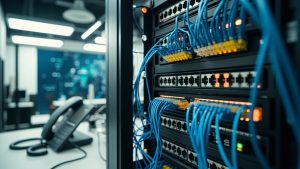
6 Common Data Center Structured Cabling Problems and Troubleshooting Guide

Twisted pair or fiber? Choosing the wrong cable type is the biggest hidden cost. After fourteen years in data center operations, what gives me headaches isn’t equipment failure — it’s the landmines buried during the cabling phase. Many clients make a snap decision to use Cat5e copper cable early in the project, only to discover when their business scales that it can’t carry 10 Gigabit. After a round of re-cabling, the cost ends up five to six times the original decision cost. The fundamental difference between twisted pair and fiber comes down to the application scenario. Copper cable suits runs of up to 90 meters…

Learn More »

Enterprise VPN Alternatives Compared: Choosing Between WireGuard, IPSec, and OpenVPN

A generational gap in encryption cores: the underlying design logic of the three protocols IPSec dates back to the 1990s, designed to build trusted tunnels over public networks. It uses the IKEv1/IKEv2 handshake protocol together with ESP (Encapsulating Security Payload), and the suite is mature enough that nearly every router, firewall, and switch supports it natively. This “textbook” security architecture gives enterprise auditors a sense of…

Learn More »

Desktop IT Operations Automation: Standardized Handling of 5 Common Issues

After more than a decade in desktop support, what I dread most is not a server going down, but 3 p.m. on a Friday, when the finance team’s reimbursement form won’t print and the boss is standing by waiting to sign off. That’s desktop support for you — all “small things,” but leave them unsolved and the big problems follow. We used to rely on people watching people: one engineer running themselves ragged handling a dozen-plus tickets a day, exhausted, and the same issues kept coming back anyway. Standardization is the way out — turning common issues into…

Learn More »

5 Security Hardening Tips for Network-Connected Printers

A Ransomware Nightmare Triggered by a “Silent Printer” In late autumn 2019, Lao Zhou, the IT manager at a tech company in Wangjing, received an urgent call from the sales team — all the printers had “gone on strike” at the same time, and the screens showed an encrypted message demanding 0.5 Bitcoin for the decryption key. Even stranger, the company’s file server also showed abnormal access logs that same night. Lao Zhou investigated for two full days, …

Learn More »

Wi-Fi Roaming Without Dropped Connections: A Configuration Field Guide

The conference room disconnect nightmare Last Wednesday afternoon, a partner at a law firm in Tuanjiehu walked out of a third-floor meeting room with a MacBook, taking a conference call on the move. At the corridor corner, the Wi-Fi signal dropped for a full six seconds—the person on the other end thought he had hung up. I have seen this scenario more than twenty times. The problem is usually not insufficient AP coverage, but poorly tuned roaming decision logic: the client hesitates between two APs and finally picks…

Learn More »