
Recently, Gartner released its 2020 Magic Quadrant for Wired and Wireless LAN Access Infrastructure, featuring 18 WLAN vendors worldwide.
In the report, Gartner expressed strong optimism about the market’s future. It predicted that by 2023, more than 90% of enterprise campuses would connect devices through intent-based networking.
In this edition of the Magic Quadrant, most vendors are clustered in the Niche Players quadrant at the bottom left, while the Challengers and Visionaries quadrants are notably sparse.
The top four vendors—Juniper Networks, HPE (Aruba), Cisco, and Extreme Networks—have increased their market shares year after year, leaving less room for the remaining vendors to compete.
Mojo Networks was excluded following its acquisition by Arista Networks.
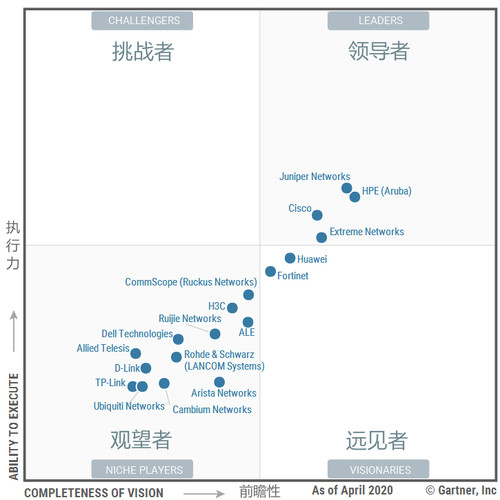
▲2020 Magic Quadrant for Wired and Wireless LAN Access Infrastructure
The Four Industry Leaders
HPE (Aruba) and Cisco’s leadership in this field is well established. Guided by a customer-first culture, HPE (Aruba) strengthened its market position through Aruba ESP (Edge Services Platform), ranking highest among all vendors for Completeness of Vision.
Through an open, programmable architecture, Cisco delivers campus network infrastructure with multivendor integration and analytical insights. Its geographically diverse business serves enterprises of all sizes, and it has appeared in the Leaders quadrant for 10 consecutive years (2011–2020).
Juniper Networks moved from the Niche Players quadrant to Visionaries and then to Leaders in just two years. Its Mist AI-driven wired and wireless portfolio has set it apart from other vendors, positioning it to pull further ahead.
After successfully integrating several acquisitions, Extreme Networks continued to refresh its product portfolio. It introduced the ExtremeCloud IQ cloud management platform and Fabric Connect solution, strengthening its position in wired and wireless LAN infrastructure.
Five Leading Chinese Vendors
Huawei delivered a strong performance, remaining the highest-ranked Chinese company in the report. Its product strategy focuses on AirEngine Wi-Fi 6. Data shows that Huawei’s Wi-Fi 6 products ranked first by market share both in China and globally (excluding North America), with shares of 49.7% and 39%, respectively.
H3C remains a Niche Player, with little change in its position. It primarily serves its domestic market, while expanding its presence in Europe, the Middle East, and Africa. In the first half of 2020, H3C’s iMC Intelligent Management Center led China’s network management software market with a 28% share.
Ruijie Networks appeared in the Niche Players quadrant for the second time. Its WIS wireless intelligent service platform combines AI, big data, and other technologies to provide network visualization, diagnostics, and optimization, and has served a cumulative total of 450 million customers. According to IDC, Ruijie Networks ranked second by market share in China’s enterprise WLAN market.
D-Link remained firmly in the second-to-last position. It realigned its product strategy to focus on the core features required by customers in vertical markets, reducing costs by avoiding unnecessary functionality.
TP-Link occupies an interesting position: it follows market trends closely but lacks differentiated product innovation. Although TP-Link can control product costs, it does not offer campus switches with 802.3bz ports, and its gateways support only Zigbee, with no support for Bluetooth or IoT modules.
A Cybersecurity Leader
Fortinet, a global cybersecurity equipment vendor, was named a Visionary in the report. Its vision centers on reducing costs, simplifying management, and lowering complexity, with a core strategy of building security-driven networks for customers.
Centralized management through FortiGate simplifies FortiSwitch deployment and configuration, enabling zero-touch provisioning, automatic discovery, and one-click assignment of VLANs and security policies. However, Fortinet trails its main competitors in integrating AI and ML to simplify network operations.
For further details, click “Read the Original” to access the full Gartner Magic Quadrant report.




